Razor's 'Manifest Destiny' Edge: "Go to the Pareto Compute Frontier, young man!"

What’s Wrong With the AI Trade?
This is an ongoing topic of conversation these days as all anyone hears about is shortages of compute and rising costs of compute while the entire AI infra basket seems to be in freefall. For some this is proving impossible to reconcile, but I do think u can rationalize this.
I think it’s kind of obvious at this point that the biggest problem is the investment narrative is actually starting to undermine itself and that is being further exacerbated by the product narrative faltering somewhat due to poor framing.
So, what do I mean by this?
I think the most interesting shift right now is that the industry's three favorite narratives are starting to conflict with each other:
- We're going to spend unprecedented amounts of money because intelligence is extraordinarily scarce.
- We're going to make intelligence so abundant that its cost approaches zero.
- We're all going to earn extraordinary returns from doing this simultaneously.
Look, it's not mathematically impossible for all three of these coexist, particularly demand expands rapidly enough, but its clearly starting to create tension in markets.
The problem for me can be broken down into three parts.
1. The capex flex is turning into a prisoner's dilemma
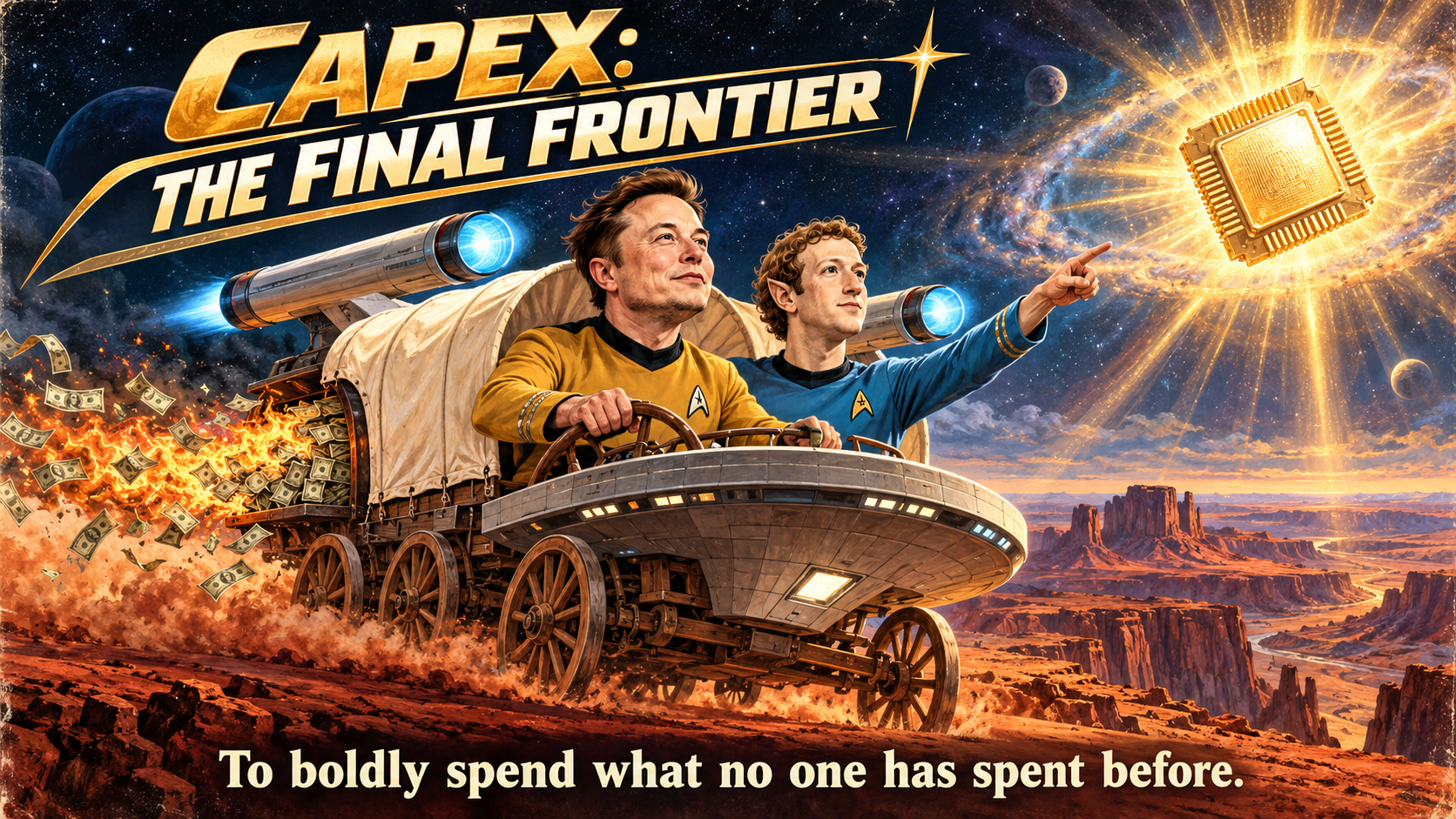
If you ask me, this is the dominant problem in the market right now. For the past few years, announcing another $100-200 billion in AI spending was interpreted as a sign of strength and demand signal. Management was demonstrating conviction, access to huge amounts capital, and the determination to win a generational business opportunity. But there's an obvious contradiction when six or seven companies simultaneously announce that they're going to spend hundreds of billions to dominate essentially the same winner takes most opportunity.They cannot all eat the biggest slice of the pie. And as far as I'm cocnerned, the more credible each company's spending plans have become, the less credible the others' prospective returns become. This is a prisoner's dilemma. Meta is kind of the poster-child for this. Them not having a frontier competitive model would put some ceiling on their ambitions rather quickly. But them having one means VM’s for potentially 3bl people in a few years and entp reps trying to sell their version of codex/claude/gemini to every G2K company as well as their own business agents to every small biz. Literally limitless ambition.
So, I think for some investors there now is an important distinction between AI being enormously successful and AI being a very profitable investment for everyone chasing it. This is despite the economic juggernauts chasing it. In fact, the more successful the giants are at making AI capabilities abundant, the greater the potential pressure on the returns to producing those capabilities. The reflexivity is starting to manifest itself in both price and narrative. It was a given the mags had a huge competitive advantage when it came to AI because of their scale/franchises/capital etc, but this is now more a signal for competitive intensity in the industry. I no longer care about the fact that u can theoretically build all the capacity needed to dominate the market yourself, but rather how obviously impaired all returns will be as u credibly believe ur competing with ur 5 other peers without a marker as to where u need to slow down.
2. The Techno Maxi Obsession with “Intelligence” over “Capability” is Starting to Backfire
Intelligence is an abstract concept that 98% of people could give two shits about on a daily basis. Superintelligence is even more abstract and almost elitist segmentation of the same nonsense. It means something to academic researchers, futurists and some maxi stock investors, but it doesn't say much about what a product actually does for an ordinary individual.
Capability is in my opinion a superior word choice. People understand the value of software that can negotiate their insurance renewal, clean their deskptop, cancel an unused subscritption they forgot about, organize their family spend, book a ticket, or resolve a customer service issue they failed to get to. Nobody needs to believe they're renting a digital Einstein to appreciate tech that delivers this for them. Folks don’t care about benchmarks or math prizes, they just want to know the shit is reliable and what its gonna cost them every month. So, far the messaging has not been there to drive that adoption and that is starting to show.
3. The investing narrative probably needs to change before the tech does
For the past few years AI has lived on a scarcity anchored investment theme. Only a handful of companies could afford to build these intelligent and now superintelligent models. Elon last week still leaned into this by saying compute will be scarce for a very long time. But now the product marketing pitch is abundance for all. Intelligence will become nearly free, ubiquitous and capable of doing almost everything for anyone. That’s what Zuck told us right?
Now, this is great as a consumer, but as investor your basically telling me u need hundreds of billions to finance scarce infra to produce something whose defining promise is that it becomes abundant and cheap for all?
Like if u had stuck me on the Meta call my one question would been:
If all your competitors execute their spending plans successfully, what happens to your expected return on capital and what would possibly lead you to ever rapidly course correct?
Because right now, a surprising amount of these trillion $ market cap giants investment narrative seems to assume that most everyone else somehow fails miserably.
So, yea there is a bump in the road for sure that has nothing to do with GPU useful life or depreciation.
And as sci-fi/tech aficiando since I was kid I kind of understand the problem
I have on a few occasions throughout the AI market channeled Halt And Catch Fire. I often like to cite Joe Macmillan’s quote “ The computer is not the thing. It’s the thing that gets us to the thing.” I think for most of these founders that remains true, and that the thing isn’t the internet as it is in Halt Catch Fire, but rather Digital God. Even Joe’s character kind of tells you that when he stumbles into the hotel room unveiling a talking Macintosh. All the astounded Joe can say in that visceral moment is “It speaks”. Funny enough, Jack Dorsey, the closest real-life Joe Macmillan, just unveiled his super-human realistic talking AI voice on Friday. Techies want to build God there really isn’t much else to say about it than that. Podcasts, Rothbard, and the Quest for Digital God are their kryptonite.
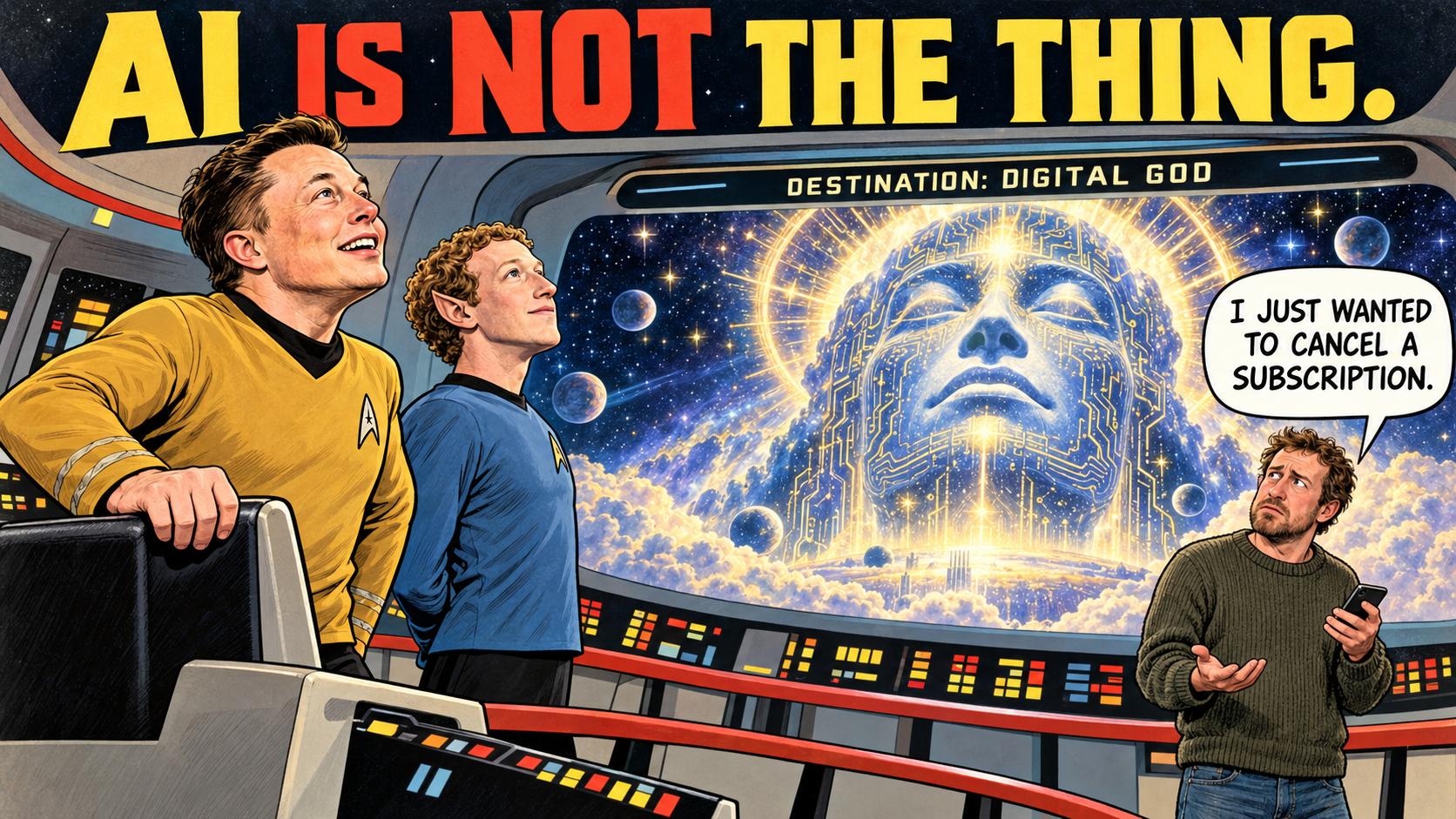
The Digital God Disconnect
I think the quest for digital god has always been and underlying problem for the AI narrative. Many Founders/CEO’s/Researchers/VC's have turned what should be a commercial tech story into an ideological or quasi religious mission. Elon talks about understanding the universe and going to Mars, Zuckerberg about personal superintelligence for all, and other AI leaders about digital minds, unprecedented abundance and fundamentally transforming human civilization. There's a point at which this all stops sounding like a product roadmap to make your shareholders richer and starts sounding like self-actualization for those worth $100bl+ on paper. I don't need 3 manifestos to go with Msft Copilot getting better!
And the DGD quest rhetoric creates its own market problems which are self-defeating.
First, it makes spending almost impossible to discipline. If you're building an agent to do P.A. work, you can ask whether another $20 billion in investment will generate an adequate return. If you're building a digital god that will transform civilization, almost any amount of spending can be rationalized. Traditional capital allocation starts looking like a failure of imagination. Zuck will have done this twice with Metaverse and now AI which is why I think Meta keeps running into these issues as he seems particularly impressionable.
Second, it confuses technological progress with economic value capture. Universal abundance might be a remarkable outcome for humanity, but abundance generally implies falling scarcity rents. Founders are effectively promising a future in which their products become extraordinarily capable and inexpensive while simultaneously asking investors to underwrite increasingly extraordinary valuations and capital commitments. Elon loves doing this and it has worked wonderfully for him so far, but at some point u get on a call and just wonder what he actually believes about the business model itself.
And as I pointed out earlier with the terminology problem, it alienates the very customers they need. The avg human (of median inferior intelligence) doesn’t wake up wondering how close humanity is to AGI. They want tech that makes their lives easier, saves them time or helps them make more money. Muse marketing was channeling that product wise way better then anyone else, but Zuck still couldn’t close the loop for this for his investors when it was just sitting there waiting to be knocked out of the park after SpaceX’s call the previous day.
And don’t think I don’t get the counter. Extraordinary missions can attract the best talent and sustain investment that wall st might prematurely reject. SpaceX itself is a prime example of this. The mars goal and rockets gets the talent that doesn’t show up for faster satellite internet and booking ur movie seat or doing ur taxes.
So, I’m not hating on the approach, but rather now pointing out that when it comes to AI it has become totally mainstream. The Elon way has become the norm for these companies and this is no bueno for what are at the end of the day businesses and not religions.
AI IS THE NEW MANIFEST DESTINY
I used to love learning about this in US history and then playing Oregon Trail to express my own frontier ambitions as I forked some river and hunted some bison. Manifest Destiny framed American westward expansion as something more than land acquisition, gold scavaging, outlaw poker, and Indian displacement. It was presented as progress and the fulfillment of a national mission as well as inspring adventure. You almost had a moral obligation as an American to expand. Star Trek premiered in 1960’s and its famous opening described Space as the final frontier. The series dialed up that American Western tradition with Captain Kirk and co effectively succeeding traditional pioneers and explorers at a time that mattered geopolitically. The Cold War era Space Program channeled American frontier mythology and married it to nationalistic goals and anti-communist political ideals. AI is now the modern successor to all this.
The tech industry and the current administration, which are often indistinguishable these days, have managed (or trying very hard depending on ur pov) to turn a commercial competition between some of the richest companies in history into a matter of national destiny. The framing is that America must win the AI race against China or all is effectively lost. I’m fine with that rhetoric even if I don’t believe it, but what exactly constitutes winning?
Having the most powerful frontier model? The cheapest inference? The largest installed compute base on domestic soil? The most datacenters in space? The greatest economic productivity gains that redistribute wealth from high end knowledge jobs which America is the richest in to tech conglomerates with almost no need for human workers eventually?
Those are obviously very different objectives, and they don't necessarily produce the same winners or some national agenda of defeating China.
Like Amazon isn't just trying to maintain American technological leadership. It's trying to protect AWS, defend Alexa's relevance and ensure that AI workloads don't migrate to competitors.
Google is defending Search, its advertising economics and its cloud business while simultaneously trying to disrupt the very interfaces on which those businesses were built.
Meta is pursuing AI capabilities that should massively strengthen its advertising business, control its next computing interface, delight all small businesses with better tooling, and reduce its dependence on platforms like Apple. Zuck never again wants to have to pay an IOS tax.
Nvidia wants AI infrastructure spending to remain enormous, while its largest customers have powerful incentives to reduce their dependence on Nvidia hardware. Jensen doesn’t seem to believe he should ever have less revenue in the subsequent year.
OpenAI and Anthropic need to establish durable businesses before their capabilities become sufficiently interchangeable with competing models. For them getting public is actually a necessity that has a running clock.
So, thhese companies aren't collectively executing a national strategy. That’s a load of crap.They're competing against one another, often with directly conflicting economic interests. It’s called capitalism.
Now, we know the national security argument isn't totally contrived. There are legitimate strategic considerations involving drones, cybersecurity, advanced chips and dependence on foreign technology. But those considerations don't automatically establish that every additional $100 billion of AI infrastructure spending is strategically necessary let alone destined to be economically productive. In fact, u could argue that intense competition and tech diffusion of this scale could serve American interests better than an expensive race to establish a handful of dominant domestic national champion AI companies.
Like what if Chinese open-weight models help U.S. companies dramatically reduce the cost of deploying AI/SI? Who wins?American consumers and businesses can benefit, likely massively, even if the frontier model providers lose pricing power.
And to be perfectly honest the nationalist framing has conveniently changed the burden of proof, and that has started to turn.
When management says it needs to spend hundreds of billions to defend its competitive position, investors can and will ask about returns.
When management says it needs to spend $100 billion to build more datacenters which the governnemt has said is paramount as America cannot afford to lose to China, questioning the expenditure becomes much more politically uncomfortable. At that point manifest destiny/nationalistic rhetoric risks becoming a subsidy to undisciplined capital allocation.
The whole thing can make ur head want explode especially if u have to have X providing reinforcement narrative feeding of this on every click. AI is simultaneously being sold as a commercial product, a religious mission and a geopolitical arms race. Each framing provides a different justification for spending, and together they make almost any level of expenditure sound defensible..
Like what if you believe national prosperity and returns to AI infrastructure investors are not the same thing? Are you now a financial heretic?
META Earnings Lessons
I didn’t forget about this one. Just needed a weekend to properly comment on this because feel it’s both a good one w respect to trading risk mgmt. and a great one w respect to AI narrative investing when its combined w SpaceX the day before.
So, my bluesky scenario for Meta a few weeks before MetaConnect was that the stock goes from $580 to about $750. Actually, I’d set roughly $730 is my indifferent point on being long. That’s generally speaking a lot to expect for a company that size without any financial driver of note, but the AI narrative gap to peers was that extreme at that point. Anyway, I was quite aggressive on that and the narrative turned very quickly with respect to Agentic/AI competitive ambitions on Muse. I had planned on skipping the print but for a few thousand shares because was kind of obvious that AI monetization vs Capex would grab the mic for a day and the neocloud/capex stock tape was signaling no Bueno on that front.
But then along came SpaceX with their 1TRL in a year spend ambitions…
The stock managed to make it to up 14% the next day, so surely a Meta long with gangbuster core biz metrics and early engagement data on MUSE etc would be at worst just fine with maybe a surprise 1-2 day overshoot up…right?
Anyway, after SpaceX, which I generally recommended to anyone not anchored to some Meta Ai winning bias to fade immediately; I added a tiny amount of Meta weekly at the money calls. I then went into the print with a plan to potentially trade it long if the knee-jerk release but pre-call reaction was benign. So, I notably upped my exposure once the stock had effectively not dropped, and for about five minutes into the conference call felt like a genius and had put those shares to sell at $750 or roughly 5-6% gain. But with the 8k dropping on the call addressing AI financing plans/board discussions, the stock started to reverse. I exited at cost on those and at $698 on what I had left of my agentic economy shares.
I could complain here about why they had to drop that filing then and not a day later cause that actually might made a difference for my trading especially with a new IR guy whose ex-pod, but reality is the setup was just too mixed macro/theme wise to try and squeeze more. SpaceX was the outlier move for a day and all the signal before it from AI stocks to google action to Meta tone shifting from Muse excitement to engagement/cost questions said skip the print. And these stocks continue to not disappoint vol wise. SpaceX had full on reversed by the next day, and waiting for Meta pre-mkt cost you and and the open cost you another 6%. All in all Meta had a 15% swing from the conference call high to end of day the following session.
I was defnitely very pleased w my risk mgmt. when this was over cause the seemingly free money chase on these can be hard to resist especially with the Spacex timing. Anyway, I still think my initial view holds that meta is uniquely positioned to be a beneficiary if u think there is less and less moat in the models. I don’t know when it will be popular for one of these CEO’s to argue that AI compute costs might massively drop, but at some point that will be a huge deal for their share prices at the expense of others. Zuck definitely doesn’t seem like he wants to break ranks, but arguing this is almost mutually beneficially to these companies at this point…well to all but one I gues.