Razor's Edge: Why Meta..
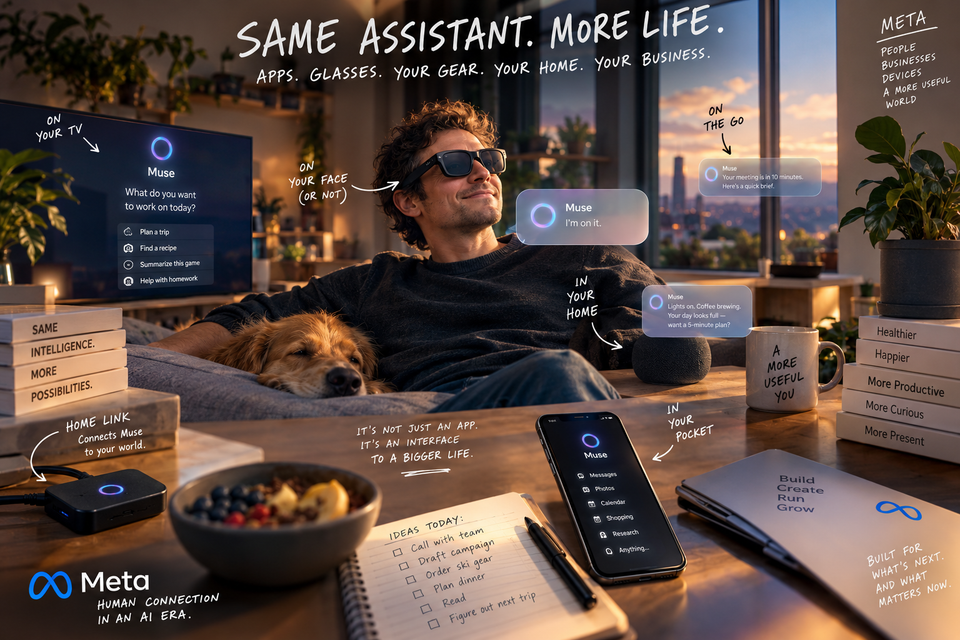
I asked Supreme to take everything I've worked on agent economy/meta research wise and turn that into a "Why Meta" investment memo in my voice.
Few things that mattered to me which get little play where...
-Meta as uniquely positioned as the Frontier in LLM's becomes insignificant.
-Meta winning on the backside of a tragedy of commons outcome in AI which could happen faster then most of us think is possible.
-Meta vs Amzn/Goog ads distinction which Zuck and co never really sell and which Ben Thompson did a good job highlighting
-Meta as business os
-Meta hardware chops now looking legit
Anyway, Supreme is getting very good but I still don't think it has my voice down. I edited like 10% of this in areas that really felt needed it, but I didn't bother with full editing. Still think this a good exercise when u have long running work with AI.
Meta: The Bull Case Inside the AI Bear Case
Why I would rather own the customer relationship than bet on intelligence staying expensive.
I increasingly think Meta is the most compelling of the large technology platforms because the best version of its AI story does not require the AI infrastructure story to keep working.
That distinction matters. You can believe the technology is extraordinary, believe agents will become widely used, and still think the industry is making increasingly questionable assumptions about what those capabilities will cost, how differentiated they will remain, and how much capital they can profitably absorb. Those are not contradictory positions. In fact, the better the technology becomes, the more important it is to distinguish between companies selling intelligence and companies using intelligence to make something else more valuable.
Meta is particularly interesting in that second category.
My central thesis is that intelligence becomes cheaper and more interchangeable faster than attention, distribution, and customer relationships do. Meta already has the latter. Its opportunity is to put increasingly capable intelligence around them, expand the economic activity it participates in, and make its existing business more productive.
Muse makes that opportunity easier to see. WhatsApp and the business-agent products make it more commercially interesting. The enterprise initiative adds another potential business opportunity that they are now better positioned to pursue then in the past. But the underlying thesis is bigger than any individual launch.
I do not need Meta to own the smartest model forever. I need it to remain very good at connecting businesses with people who might want what they sell.
The spending was obvious. The product was not.
For a long time, the skeptical interpretation of Meta was easy to construct. Take the metaverse ambitions, Reality Labs, the AI research organization, and the expanding infrastructure budget, put them in one bucket, and ask whether a fantastic advertising business was funding another set of expensive distractions.
I think that framing obscured an important distinction: AI investment that improves the existing business does not necessarily arrive with a separate revenue line announcing its contribution.
When intelligence improves recommendations, advertising performance, or the usefulness of business interactions, the financial benefit can appear inside an apparently familiar business. The spending is conspicuous. The incremental return is harder to isolate.
Meta’s second-quarter results illustrate the tension. Revenue increased 28% to $60.8 billion, and its family of applications reached 3.60 billion daily active people. Management explicitly credited AI with accelerating the core business. Those numbers do not tell us precisely how much growth AI caused, but they certainly do not describe a company waiting for its first AI monetization opportunity. Meta
The issue was not an absence of monetization. It was an absence of a sufficiently tangible product story to connect the existing business with the ambition behind the spending.
Muse begins to close that gap.
Meta launched Muse on September 8 as a personal agent that can take actions across connected applications, operating through its own app or WhatsApp. It supplies the computing environment in which the agent works rather than expecting the user to assemble one. By the September 29 business-product announcement, Meta described availability in the United States and Canada. About Facebook
The important point is not that Meta invented the agent. It is that the product is being packaged around what an ordinary person wants: tell something what needs to get done and have it handle the work.
Most consumers do not want an agent framework. They do not want to manage model selection, configure infrastructure, or become experts in connecting tools. They want a useful assistant somewhere they already feel comfortable communicating.
That is a product and distribution problem as much as a model problem. Being first to demonstrate a capability does not automatically make you best positioned to distribute it.
I am not treating early interest in Muse as proof of a permanent consumer franchise. That still requires sustained usage, reliability, trust, and sensible serving costs. What has changed is that Meta’s AI ambition is becoming recognizable as a product strategy rather than something investors have to reconstruct from spending plans and research announcements.
You can automate the errand. You cannot outsource the enjoyment.
Ben Thompson’s distinction between Meta advertising and Google or Amazon advertising gets to the heart of why I think the businesses have different exposures to agents.
A chatbot changes how a person gets information. The person is still present, reading the answer, considering the options, and making decisions. A sufficiently capable agent can remove the person from much of that intermediate process.
That is a much more consequential change for businesses monetizing those intermediate interactions.
Google sells advertising against searches and across other properties. Amazon’s Sponsored Products can appear at the top of, within, or alongside shopping results and on product pages. An agent that completes a defined purchasing task could compress some of those human browsing opportunities. Google
But consider the difference between asking an agent to buy a particular household appliance and opening Instagram because you want to see something entertaining.
In the first case, the agent can take over the activity without defeating its purpose. You still get the appliance.
In the second case, having your agent watch the video does not deliver the same benefit. You do not experience the enjoyment by proxy.
Not every interaction with a screen is an administrative burden waiting to be automated. Sometimes the interaction is the product. Zuck has sucked at getting this message across, but its becoming more and more obvious this social human surface area is gonna matter more and faster than many people think.
This is why I think the blanket argument that agents threaten advertising misses the important question: Which part of the advertising process?
Imagine someone sees a creator wearing a jacket, decides they want it, and tells an agent to find their size and buy it. The agent may eliminate several searches, comparison pages, and shopping sessions. It has not eliminated the interaction that made the person want the jacket.
The purchase instruction arrives with a preference already embedded in it.
Thompson’s recent essay makes a related argument: as agents make execution more abundant, inspiration and deciding what to do become more important. I think that is a useful starting point for understanding where the economics could move. Stratechery by Ben Thompson
An agent can make it easier to act on a desire without becoming the source of that desire. For Meta, that creates an important possibility: it can continue to generate valuable demand even when another company’s agent completes the transaction.
Owning the winning purchasing agent is therefore additional upside. It is not a prerequisite for this part of the Meta thesis.
When every business has an agent, the customer becomes the problem again.
The next step is where I think the argument becomes more bullish than simply saying Meta’s ads survive.
Early access to a capable agent can give a small business an advantage. The owner can create better marketing, respond faster, analyze operations, and eliminate administrative work that previously went undone.
But what happens when the competitors have those capabilities too?
The productivity improvement does not disappear. The relative advantage does.
If every business can create a competent campaign, maintain an attractive website, answer inquiries promptly, and analyze its sales, then access to those capabilities stops being a sufficient explanation for why one business should outperform another.
The problem returns to getting the customer to notice, trust, and choose you.
This is the point I keep coming back to. Making it easier to produce marketing does not make it equally easy to acquire attention. A world with vastly more capable producers does not automatically contain vastly more willing buyers, more disposable income, or more hours in the day.
My expectation is that creators, reputation, recognizable brands, and social influence become more important in that environment, not less. Annoyingly, self-promotion may become even more valuable.
There is a meaningful difference between telling an agent, “Find me a jacket,” and telling it, “Buy me that jacket.” The first instruction leaves considerable discretion to the agent. The second establishes a preference before the agent begins optimizing the transaction.
For businesses selling products where taste, identity, aspiration, or trust matter, getting into that second instruction could be extremely valuable.
That does not mean every advertising dollar migrates to Meta. It means the ability to establish preference could become more valuable relative to the increasingly cheap work of executing the purchase.
There is also a potential benefit to merchant economics. Consider a business that pays to generate interest and subsequently pays again to recapture the same customer during a search. An agent that carries the original preference directly through to a purchase might reduce that second expense.
The savings could stay with the merchant, flow to the consumer, or be captured by the agent provider. But they could also improve the economics of the original demand-creation spend.
I do not need to assume that consumers suddenly buy ten times as many things. There can be substantial changes in who captures the economics of a transaction without a corresponding explosion in the number of transactions.
The bullish argument is not that AI makes advertising universally more valuable. It is that AI may make creating desire more valuable relative to intercepting an already-decided purchase.
WhatsApp and Muse could become the operating interface for a small business.
This is where the advertising thesis connects to a much larger product opportunity.
The way I think about the pieces is straightforward. Consumer Muse works on behalf of the customer. Meta Business Agent works on behalf of the business in customer interactions. Muse for Small Business works on behalf of the owner.
These are related roles, but they are not the same role.
In June, Meta said more than one million businesses were already using Business Agents on WhatsApp and Messenger. It also reported more than one billion daily active business threads across WhatsApp, Messenger, and Instagram. Its stated capabilities include answering questions, recommending products, qualifying leads, booking appointments, and closing sales. Those conversation figures are not transaction counts, but they establish that Meta is building around an existing commercial behavior rather than trying to invent one. About Facebook
Muse for Small Business extends the proposition. Meta’s September 29 announcement describes connections to tools including Shopify, QuickBooks, Canva, Slack, and Stripe, alongside Facebook Pages, Instagram professional-account analytics, and Meta advertising accounts. Publishing, sending, and spending require the user’s approval. About Facebook
The interesting end state is not another customer-service chatbot. It is an interface through which the owner coordinates the business.
Consider a hypothetical retailer asking: “What sold this week, which products are getting inquiries but not converting, what inventory needs attention, and what campaign should we run next?”
A useful agent could assemble the relevant information, recommend actions, prepare the campaign, and coordinate the follow-through. A customer-facing agent could then handle the inquiries generated by that campaign.
That would connect work currently spread across marketing, customer service, commerce, and administration.
Calling this an SMB operating system does not mean Meta has to replace every underlying application. QuickBooks could remain the accounting system. Shopify could remain the storefront. Canva could remain the design tool.
The question is where the owner begins.
Does the owner separately open each application, learn its interface, and coordinate the work? Or does the owner tell an agent what needs to happen and let it use the applications?
Owning that starting point could be valuable even while other software companies retain the underlying systems. The strategic prize is the daily operating relationship, not necessarily every database and feature underneath it.
For Meta, the connection to its existing business is unusually direct. Help a merchant respond to more inquiries, convert more potential customers, and serve those customers better, and the merchant may get a better return on the demand Meta already helps generate.
That creates more than one way to justify the product economically. Some capabilities can be sold directly. Others can strengthen advertising performance, commercial messaging, or the broader merchant relationship.
A standalone software provider needs its software economics to work. Meta has the possibility of making useful software support economics elsewhere in the relationship.
That is a powerful subsidy mechanism, provided the merchant genuinely benefits. A business-owner agent that simply recommends spending more on Meta advertising would quickly become an untrustworthy salesperson rather than an indispensable assistant.
Nor does this thesis require private agent conversations to become advertising data. Meta explicitly says Muse conversations and data inside the user’s virtual machine are not shared with its advertising systems. The opportunity rests on distribution, useful workflows, and commercial outcomes—not an assumption of unrestricted access to private information. About Facebook
CJ Desai makes the commercialization effort more serious.
The appointment of CJ Desai is interesting in this context. I have shared my views on how this can be narrative interrupting right now as Meta already has more than enough going on, but he is no doubt the right person for this full court press.
Meta announced its Enterprise Platform on September 28, with Desai joining as chief enterprise platform officer, reporting to Zuckerberg. The initial scope includes Muse, Meta Business Agent, Muse API, and Muse Code. Desai’s background includes MongoDB, Cloudflare, and ServiceNow. About Facebook
I read this as an effort to address a familiar gap: having powerful internal technology is not the same thing as having products outside businesses can reliably deploy.
Enterprise customers need integrations, controls, support, predictable commercial terms, and somebody responsible for making the product work beyond a demonstration. Those requirements do not disappear because the underlying model becomes more capable.
Desai’s experience makes the attempt more credible. It does not establish product-market fit, and I would not assign a large enterprise software valuation simply because Meta has announced an organizational structure.
There is also a distinction between extending existing commercial relationships and deciding to compete everywhere in enterprise technology.
Thompson, despite his enthusiasm for Meta’s consumer-agent opportunity, has explicitly criticized the enterprise expansion. I think that concern is worth taking seriously. Stratechery by Ben Thompson
The version I find attractive begins with businesses Meta already serves and problems closely connected to their growth and operations. The less attractive version is an unfocused attempt to become another general-purpose cloud provider because the infrastructure happens to exist.
I do not need Meta to become the next Microsoft for this investment to work. A focused commercialization effort could be valuable. An indiscriminate expansion would deserve much more skepticism.
The AI bear case can improve Meta’s long-term economics.
This is the part of the thesis that makes Meta particularly interesting to me.
I use these tools constantly, and increasingly the issue is duplication rather than a shortage of impressive capabilities. The products are not identical. Reliability, workflow design, integrations, and particular strengths still matter. But I am increasingly skeptical that every major provider can sustain a differentiated premium simply by being another very capable source of intelligence.
For a business primarily selling that intelligence, convergence creates a pricing problem.
For a business using intelligence to monetize something else, convergence can be a good outcome.
Meta does not need to charge the user the full standalone economic value of every AI capability it provides. Intelligence can improve the advertising business, make commercial conversations more productive, strengthen an agent relationship, or reduce the cost of serving a merchant.
The underlying capability becoming cheaper can therefore strengthen the economics of the surrounding business.
This is also why I separate agent adoption from the assumption of ever-accelerating infrastructure orders. A successful consumer-agent product can validate capacity a hyperscaler has already built or planned. Gross computing activity is not the same thing as net incremental procurement.
The fact that a product is finally useful does not tell us that the supplier’s existing capital plan was too small.
Now, Meta is not immune to an infrastructure bust. It is spending enormous amounts itself. Its latest annual capital-expenditure guidance is $130–145 billion, including finance-lease principal payments. In the second quarter, $31.9 billion of operating cash flow translated into only $784 million of free cash flow after investment. There is no honest version of this argument in which those commitments do not matter. Meta
Cheaper future equipment does not erase an expensive installed base. Lower external inference prices do not immediately eliminate depreciation. And management can absorb every efficiency improvement by choosing to spend even more though i find that unlikely considering how this tech works in practice.
The favorable scenario is more specific: useful AI demand remains strong while competition, optimization, and infrastructure supply drive down the cost of delivering it.
In that world, Meta could have overpaid for some capacity in the race/buildout phase and still emerge with a stronger long-term business model. Both things can be true.
A cloud provider can also benefit from lower costs and expanding demand. The distinction is not that falling prices hurt every supplier. It is that Meta’s core revenue does not require customers to keep paying a premium for units of intelligence.
That is a different exposure from underwriting the continuing scarcity value of compute.
Reality Labs Metaverse Narrative Drag Shifted For me after Connect.
There is another reason I have become more constructive on Meta, and it is something I do not think should be relegated to a footnote about smart glasses.
I own an Apple Vision Pro. I have also done long/short work on next-gen battery companies tied to augmented and virtual reality. I am not coming to this as someone who sees a futuristic hardware demonstration and assumes the difficult problems have all been solved.
That background made Meta Connect more impressive to me, not less. Honestly, parts of it made me feel a little stupid for having bought the Vision Pro. If Meta can deliver enough of the experiences that make spatial computing compelling in the footprint it demonstrated, the practical comparison becomes very different.
The new Meta VR Glasses are advertised at approximately 100 grams on the face, with a 5K micro-OLED display system, eye and hand input, and virtual workspaces. Meta plans to sell them for $1,299.99 beginning in spring 2027. These are announced specifications and capabilities, not something I have independently tested in a shipping product. But they make the engineering ambition substantially more tangible. Meta
To be precise, I am not claiming Meta has compressed every capability of Vision Pro into a completely self-contained pair of ordinary glasses. Its design moves computing, storage, and the battery into a separate puck connected by an optical tether. Meta also describes custom compact pancake lenses and a magnesium-alloy frame. The 100-gram figure is therefore the eyewear, not the entire system. Meta
That distinction does not diminish what interests me. Where the weight sits is part of the product. Moving work off the face while preserving a useful experience is a legitimate engineering solution, not a reason to dismiss the improvement.
Apple’s current Vision Pro specifications list 750–800 grams including its Light Seal and counterbalanced Dual Knit Band, plus a separate 353-gram battery. Apple also offers a 23-million-pixel display system and substantial onboard computing. These are different design choices, and I am not assuming equivalent image quality, computing performance, or software capability. Apple
But a consumer product does not have to match every specification to become the more attractive product. The relevant question is whether it delivers the experiences people value with sufficiently less friction that they use it more.
A device you are willing to wear can be more valuable than a more capable device you keep deciding not to put on.
The engineering capability deserves a different valuation from the original metaverse pitch.
My battery research also makes me sensitive to the difference between an attractive component claim and a useful finished system. A battery breakthrough is not, by itself, a wearable product. Nor does a smaller form factor prove that somebody has discovered miraculous battery chemistry.
What Meta has described is a system-level approach: change the optics, change the construction, redistribute the electronics, and integrate the input methods and software around that architecture. That is the kind of work I find meaningful. Meta
For me, Connect crossed an important credibility threshold. I no longer think it makes sense to discuss Meta as an advertising company dabbling in hardware. It is a serious hardware developer.
That does not retroactively make every Reality Labs project sensible. It certainly does not establish that every dollar spent will earn an acceptable return. But the original application thesis and the underlying engineering capability are not the same asset.
A company can be wrong about how quickly people will want to inhabit a virtual world while still building valuable capabilities for the devices through which they eventually interact with AI.
I think that distinction has been missing from the discussion. “The metaverse did not develop as originally imagined” is not equivalent to “the research and development produced nothing useful.”
The investment question should now be how broadly Meta can apply those capabilities—and whether the resulting products generate enough value to justify the continuing expense.
The glasses do not have to replace the phone to matter.
It is also important to distinguish the products. The new VR Glasses make the miniaturization and spatial-computing argument. Everyday smart glasses make a different argument about convenient access to an assistant.
Meta’s Connect announcements included camera-free audio glasses, an expanded camera-equipped lineup, and further development of its display glasses. The eyewear expansion is being built with EssilorLuxottica, rather than Meta trying to solve fashion, fit, and optical distribution entirely on its own. Meta also announced that Muse would extend to its glasses. Meta
The potential connection is straightforward. An assistant becomes more useful when reaching it requires less effort. For suitable tasks, speaking to something you are already wearing could be a better interface than taking out a phone, finding an application, and explaining what you need.
That does not require everyone to abandon their smartphone. It requires a meaningful set of interactions to begin somewhere else.
Nor does it require every pair of glasses to provide a full spatial-computing experience. A simpler device that handles communication and useful assistance well may have a much broader audience than a device designed to do everything.
The commercial opportunity, in my view, is not just selling the hardware. It is establishing the place where a consumer increasingly begins a request.
Owning attention is better when you also have a claim on the interface.
This adds something important to the advertising thesis.
The argument that people will continue enjoying Instagram and Reels is persuasive, but it should not become complacency about how those experiences are accessed. If agents change the interface, Meta should want a position in the interface—not merely confidence that its existing applications will remain indispensable.
Meta itself identifies dependence on mobile operating systems and policies it does not control as a business risk. That is an existing vulnerability, not a hypothetical objection invented for the agent era. Meta
Successful hardware would not eliminate every dependency. But it could give Meta greater control over how the assistant is invoked, how people interact with it, and how its services are presented.
That is potentially both offensive and defensive. It opens new ways to serve consumers while reducing the risk that another company becomes the mandatory intermediary between Meta and those consumers.
I do not need to assume advertisements start appearing across somebody’s field of vision. The first-order value could be a stronger assistant relationship, more convenient communication, paid services, or commerce. The business model should follow a useful product rather than dictate an intrusive one.
Meta’s opportunity is to own more of the customer interaction, not simply find another screen on which to place an advertisement.
Cheaper intelligence could make the hardware work better economically.
This is also where hardware connects directly to my broader view of AI deflation.
If capable intelligence becomes cheaper to deliver, the economics of putting useful assistance into a widely distributed consumer device can improve. Meta would not need to preserve a high standalone price for intelligence to benefit. It could use the improvement to make the surrounding product more useful or less expensive to operate.
That does not mean a new model suddenly solves battery life, thermal constraints, or manufacturing yields. Those still require engineering. But it means increasingly accessible intelligence can complement capabilities Meta has already spent years developing.
My bet is that access to a competitive model becomes easier to obtain than the combination of a well-designed wearable, reliable software, consumer acceptance, and distribution.
That is why the hardware matters to the investment case. It is not a separate moonshot stapled onto an advertising company. It could become another way for Meta to own the scarce side of the equation—the consumer relationship—while the intelligence serving that relationship becomes cheaper.
Connect did not prove that Reality Labs has earned its cost of capital. It did make the claim that Meta has nothing valuable to show for its hardware investment much harder to sustain.
Also, Meta does not need you to replace your hardware...
What caught my attention over this weekend was not new futuristic AI gadgets. My feed was full of people getting Muse working through hardware that already existed.
That is a different proposition from asking consumers to buy an entirely new collection of devices before an assistant becomes useful.
Meta’s open-source software provides a route to repurposing existing equipment. Its device integrations pair with the Muse application, bringing that hardware into the user’s existing assistant relationship. The opportunity is to change what the hardware does without requiring Meta to manufacture and distribute a replacement. GitHub
The Home Link dongle makes the same ambition visible from another direction. Connect the assistant to the home network and let it work with compatible equipment already in the house.
My read is that Meta wants to become the assistant for the hardware you own—not just the assistant bundled with hardware it sells.
That makes the potential competitive threat more interesting. In this scenario, a manufacturer could retain its device in the home while losing its position as the interface through which the customer operates it. The hardware remains useful; the relationship through which the customer gives instructions shifts elsewhere.
It also gives Meta a way to expand without waiting for a replacement cycle. Asking somebody to buy an expensive new device is a much larger decision than letting them make existing equipment more useful. The hardware acquisition and installation have already happened. Meta’s opportunity is to add the intelligence and become the preferred point of interaction.
This is why I see the Connect demonstrations and the open-source activity as complementary rather than contradictory. One makes me more confident that Meta can build differentiated hardware where the physical design matters. The other suggests it does not intend to make ownership of that hardware a prerequisite for participating in the ecosystem.
Build new hardware where it enables a genuinely better experience. Use the existing installed base everywhere else.
There is still a considerable distance between enthusiastic users modifying devices and a reliable mass-market service. Meta’s current gadget program is explicitly experimental, and its access-token terms restrict commercial distribution. These demonstrations establish a route, not a finished consumer platform. Muse Gadgets
But the strategic question has changed. It is no longer simply, “How many Meta devices will consumers buy?” It is, “How much of the hardware consumers already own could become accessible through Meta’s assistant?”
That fits the broader investment thesis. Cheaper intelligence could make an existing installed base more useful without requiring an equivalent surge in new hardware purchases. Meta could benefit through a more valuable, more habitual assistant relationship.
Why I prefer the setup to Google, Amazon, and Microsoft.
Google is the closest alternative because it also combines distribution, advertisers, and a major consumer footprint. YouTube belongs on the protected side of much of this argument: Google itself markets the ability to create demand through creators and content before customers have made up their minds. Google
I am not arguing that Google disappears. I am arguing that its transition requires protecting and adapting an existing intent-monetization business while the interface through which that intent is expressed changes. Meta has an opportunity to move further into executing intent without depending as heavily on preserving the search journey.
Amazon likewise should not be reduced to a collection of sponsored listings. There is a difference between an agent bypassing a shopping page and replacing the commercial service behind it. But an order continuing to occur does not guarantee that the same advertising economics survive around the order. Amazon’s own description of Sponsored Products makes clear how closely those placements connect to shopping results and product pages. Amazon Ads
Microsoft is the strongest counterargument to treating Meta’s distribution advantage as unique. It already combines enterprise applications with cloud infrastructure, and cheaper intelligence can make those applications more useful too. Its business is not simply reselling compute. Microsoft
My relative preference is that Meta can monetize improvements through customer acquisition and commercial outcomes, rather than needing every improvement to translate into a larger technology budget. That is not an exclusive advantage, but it is an attractive business model when the cost of the underlying technology is falling.
The argument is therefore not that the other three lose. It is that Meta offers a particularly appealing combination of a durable existing monetization engine, an expanding role in consumers’ and merchants’ lives, and potential upside from the commoditization of the technology enabling that expansion.
Valuation supports the argument; it does not substitute for it.
I also like starting with a valuation that does not appear to require Meta’s entire AI ambition to succeed. This isn't the no brainer setup it was a few weeks ago, but it does remain a tailwind.
Using October 2 share prices and the currently accessible adjusted earnings forecasts, the basic screen looks like this:
| Company | Earnings period | Estimated adjusted EPS | Price/earnings |
|---|---|---|---|
| Meta | Calendar 2026 | $30.79 | 23.6× |
| Alphabet | Calendar 2026 | $11.81 | 29.1× |
| Amazon | Calendar 2026 | $8.31 | 30.3× |
| Microsoft | Fiscal year ending June 2027 | $19.75 | 26.2× |
Sources: published consensus forecasts updated September 30–October 2. Microsoft’s period is different, so this is not a fully calendar-aligned comparison. Adjusted earnings definitions also require care. StockAnalysis.com
The cleaner same-period comparison puts Meta below Alphabet and Amazon. The Microsoft comparison is less precise, and I would not manufacture a sweeping relative-value conclusion from mismatched fiscal years.
More importantly, a lower multiple is not automatically a mispricing. Growth, capital intensity, business quality, and the eventual conversion of earnings into cash all matter.
My argument is that Meta’s business configuration is becoming more attractive while the valuation remains reasonable. The potential upside comes from sustained core earnings power, a more productive merchant relationship, successful agent products, and eventually better cash conversion—not simply declaring every dollar of AI investment temporary and adding it back.
The investment ultimately needs evidence that operating progress is reaching shareholders. A compelling narrative with permanently disappointing free cash flow is not enough.
What would change my mind?
The most important risks follow directly from the thesis.
Meta has to retain human attention. Agents might also weaken advertising economics by recommending substitutes, discouraging impulse purchases, or moving preference formation into another interface. The fact that Instagram still has viewers would not, by itself, prove that its ads remain equally valuable.
The agent products have to earn trust and become habitual. Launch excitement is not the same thing as a durable operating relationship. On the business side, more conversations and more automated actions are not sufficient; merchants need better outcomes.
And Meta has to demonstrate capital discipline. The benefits of cheaper intelligence only become attractive shareholder economics if management eventually allows some of those benefits to become cash rather than another justification for expanding the spending plan.
Those are real conditions. But none requires permanent leadership on every model benchmark or an endless acceleration in industry infrastructure spending.
That is why I find the setup compelling.
If agents become widely useful, Meta has a route to participate. If capable models become increasingly interchangeable, its distribution can matter more. If useful intelligence becomes substantially cheaper to deliver, the economics of serving its existing consumer and business relationships can improve.
I do not think AI eliminates scarcity. I think it changes what is scarce.
The ability to generate content, execute administrative work, and navigate software is becoming less differentiated. The ability to earn somebody’s attention, establish a preference, and connect a business with a customer does not become abundant simply because the software gets better.
I would rather own a business that can benefit from intelligence becoming cheap than one whose valuation requires intelligence to remain expensive. Meta is increasingly the clearest expression of that preference.